I put on a song last week and was instantly thirteen years old, sitting in the back seat of a Maruti 800, arguing with my brother over the tape deck. That’s not a metaphor. That’s my hippocampus doing exactly what fifty years of memory research says it will do, and every brand running a 2000s-themed campaign right now is counting on your hippocampus doing the same thing to you. Read the upcoming articles from Best AI Digital Marketing Blog in Chennai | MarComMaverick
Open any feed today and you’ll find low-rise jeans, dial-up sound effects, and jingles that haven’t aired since Door Darshan ruled the evening slot. This isn’t a coincidence, and it isn’t just a costume party. It’s digital marketing catching up to what memory scientists have known for two decades: nostalgia is not decoration; it’s medicine, and advertising has finally figured out how to prescribe it. That’s exactly the kind of pattern we exist to decode at MarComMaverick, India’s Best AI Digital Marketing Blog in India for digital marketing, advertising, and marketing strategies before they hit the mainstream.
Why Every Ad Suddenly Looks Like 2004
Depending on which report you trust, “nostalgia marketing” searches are up roughly 300 per cent since 2020, and nostalgia-tagged content on short-video platforms has racked up billions of views in the past year alone. Old Navy brought back Paris Hilton for a full 2000s fashion moment. Kellogg’s put toys back in cereal boxes for the first time in over a decade. A well-known underwear brand’s throwback-adjacent campaign posted a genuinely startling year-over-year sales jump within a week of launch. None of this reads as a fluke once you notice the pattern: brands aren’t reviving the 2000s because designers ran out of ideas. They’re reviving it because audiences are anxious, and the past feels safer than the present.
This is where advertising quietly borrowed a concept straight out of a psychology journal.
The Memory Science Behind the Retro Wave
For most of the twentieth century, nostalgia had a decidedly negative reputation. Physicians once treated it as a genuine illness. Modern memory research has completely flipped that verdict. Psychologists Constantine Sedikides and Tim Wildschut, whose decades of work at the University of Southampton form the backbone of contemporary nostalgia science, describe nostalgia as a regulatory emotion: something the mind reaches for specifically when it needs steadying. Their research, along with related studies, has repeatedly found that nostalgia buffers people against existential unease, social disconnection, and plain old uncertainty about the future, rather than causing any of it.
Translate that into consumer psychology terms and the retro advertising wave stops looking like a trend and starts looking like a coping mechanism with a media budget behind it. A 2025 study in the journal Psychology & Marketing found that nostalgic ads improve brand recall more effectively than purely factual ones, precisely because they reactivate autobiographical memory rather than simply presenting information. Your brain doesn’t process a nostalgic ad the way it processes a spec sheet. It processes it the way it processes a home movie, complete with the dopamine hit that comes from a genuinely warm memory resurfacing on cue. That is neuromarketing in its purest form, and it explains why nostalgic campaigns keep outperforming purely rational ones on every measure that matters to marketing strategies: recall, likeability, and distinctiveness all move together once a real memory gets triggered.
Three Generations, Three Very Different Nostalgias
Here’s the part most retro campaigns get wrong: nostalgia isn’t one emotion shared equally across an audience. It’s at least three different emotions wearing the same aesthetic.
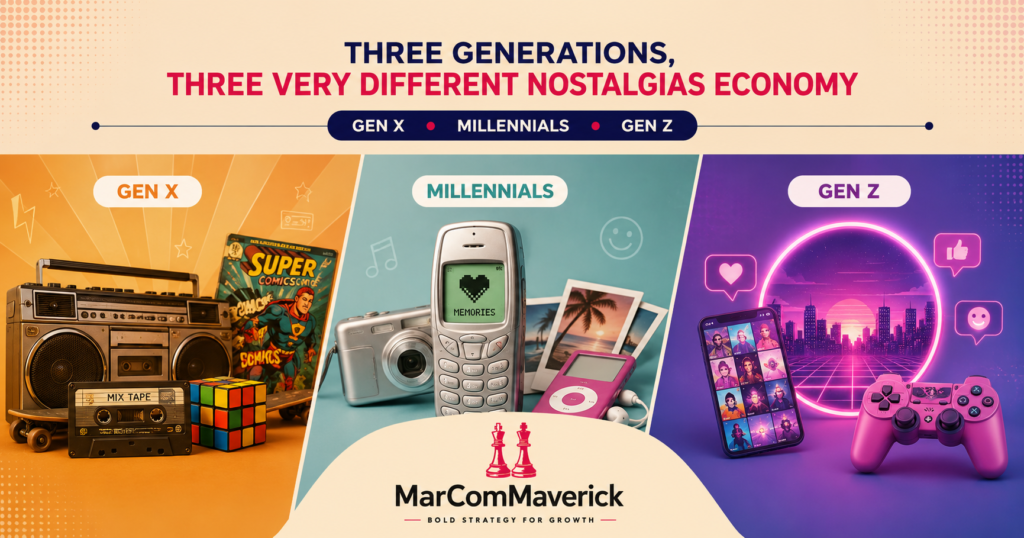
Millennials get the real thing. A 2000s reference lands as a genuine autobiographical memory: an actual childhood bedroom, an actual first phone, an actual mixtape. This is nostalgia in its textbook form, and it’s the easiest version for marketing strategies to get right, because the emotional wiring already exists; the brand just has to knock politely.
Gen Z gets something psychologists sometimes call anemoia: nostalgia for a time they didn’t personally live through. They weren’t old enough to feel Y2K the first time, so the appeal isn’t memory; it’s inherited aesthetic curiosity, filtered through older siblings, parents, and an endless scroll of archival content. Brands chasing Gen Z with 2000s advertising are selling a fantasy of a decade, not a memory of one, and the marketing strategies that work here lean into discovery and irony rather than sentimentality.
Gen X, meanwhile, rarely gets addressed by this wave at all, which is its own kind of oversight. This is the generation that actually lived through the original ads being remixed today, often as the target audience the first time around. A subtler, less ironic form of retro advertising, one that treats their nostalgia as lived experience rather than an aesthetic trend, tends to land with real credibility for this group, precisely because it isn’t trying quite so hard.
Any brand running one retro campaign across all three groups and expecting one reaction is misreading the psychology entirely. Good marketing strategies split the creative, not just the media plan.
Building Marketing Strategies Around Real Memory, Not Just Aesthetic
For Indian brands, the raw material for nostalgia is genuinely abundant: Doordarshan jingles, 90s cricket commentary, STD booth signage, the specific ringtone of a Nokia handset, and the exact texture of an Amul hoarding. The mistake most digital marketing teams make is treating these as props rather than triggers. A VHS filter slapped onto an otherwise generic ad is nostalgia-washing, and audiences, especially Gen Z, can smell the difference between a genuine memory cue and a rented one.
The stronger approach uses AI tools to work out which specific memory cue actually lands with which cohort, rather than guessing. Sentiment-tracking AI tools can flag which decade, sound, or visual reference is generating real engagement versus polite scrolling past, and personalisation AI tools can then match the right nostalgic trigger to the right age group instead of running one retro aesthetic at everyone. This is where AI tools genuinely earn their keep in a nostalgia campaign: not by generating the retro visual, which any designer can do, but by finding out which memory is worth reviving in the first place. Recommendation AI tools, layered on top, can even decide which platform sees which era-specific cue, so a millennial’s feed and a Gen Z feed can carry the same brand message wrapped in two entirely different memories.
Omnichannel marketing discipline matters just as much here as the memory science does. A nostalgic sound cue that only lives in a television spot loses most of its power; the same jingle needs to travel across Instagram Reels, YouTube pre-rolls, and even on-hold music for customer care so the memory gets reinforced everywhere a customer meets the brand rather than once. Genuinely well-built omnichannel marketing turns a single nostalgic trigger into a recurring emotional touchpoint, and that repetition is exactly what strengthens the autobiographical memory link over time. A campaign that nails the memory cue but confines it to one channel is leaving most of its omnichannel marketing value on the table, and a genuinely joined-up omnichannel marketing plan is what separates a viral moment from a lasting brand association.
None of this works as a one-off stunt. The brands earning real loyalty from the nostalgia economy are the ones treating memory as an actual marketing strategy asset, tracked with AI tools and reinforced through omnichannel marketing with the same rigour as any performance metric, not just an aesthetic borrowed for a season. Advertising has always tried to make people feel something. Memory science, paired with the right AI tools and a properly built omnichannel marketing plan, has just handed the industry a far more precise map of exactly which feeling to aim for and exactly why it works. That’s the kind of decoding we do daily at MarComMaverick, the Best AI Digital Marketing Blog in India for brands who want their advertising to feel less like a costume and more like a memory worth having.
The Bigger Ideas Behind This Piece
A few broader concepts sit underneath everything above, for readers who want to go deeper:
- Nostalgia science – The psychological research, led largely by Sedikides and Wildschut, shows nostalgia functions as a regulatory emotion that buffers against anxiety and uncertainty rather than causing it.
- Autobiographical memory – The personal, self-referential memory system that nostalgic advertising deliberately reactivates to strengthen brand recall.
- Consumer psychology – How emotional states, particularly economic anxiety, shape which kinds of messaging actually land with an audience.
- Neuromarketing – The study of how the brain’s reward and memory systems respond differently to emotionally resonant content than to purely factual content.
- Generational cohort theory – The framework explaining why the same nostalgic aesthetic produces genuinely different emotional responses in Gen Z, millennials, and Gen X.
- Omnichannel marketing – The discipline of reinforcing a single emotional or memory trigger consistently across every platform a brand appears on.
If any of these deserve a deeper dive, that’s exactly the kind of decoding you’ll find on my Medium page and across upcoming pieces on MarComMaverick, India’s Best AI Digital Marketing Blog in India for brands that want their marketing strategies, AI tools, and omnichannel marketing plans to feel less manufactured and more remembered.
#DigitalMarketing #Advertising #MarketingStrategies #AITools #OmnichannelMarketing #NostalgiaMarketing #ConsumerPsychology #Neuromarketing #GenZ #MarComMaverick #Millennials #GenX
Read the article in LinkedIn and Medium Platform
Dr. Chitra K. Ravishankaran holds a doctorate in advertising and marketing and writes on the psychology, science, and strategy behind digital marketing, advertising, and marketing strategies for Indian brands. Connect with her on LinkedIn, read more of her thinking on Medium, and explore more from India’s best AI digital marketing blog in India at MarComMaverick.