
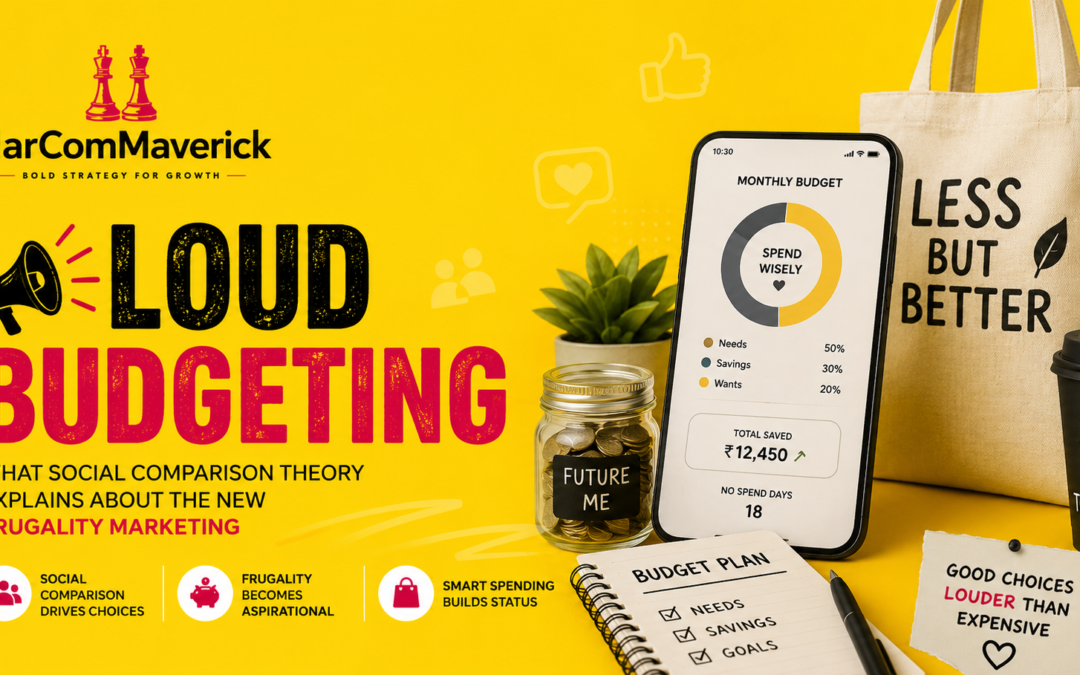
A friend of mine announced on her Instagram close-friends story last week that she was “not doing takeout this month, building the house fund”. Forty people saw it. Twelve replied with their own version of the same confession. Nobody was ashamed. Everybody felt a little braver. That, right there, is the whole trend in one screenshot. Welcome to loud budgeting, the moment advertising has to reckon with a generation that got tired of pretending. Read the upcoming articles from Best AI Digital Marketing Blog in Chennai | MarComMaverick
I’m Dr. Chitra K. Ravishankaran, and after two decades in digital marketing, I’ve watched aspirational advertising run on one assumption: people spend to signal status upward, quietly, and hide the budget behind the bag. Gen Z broke that assumption in public, on purpose, with captions. Understanding why requires dusting off a fifty-year-old psychology theory, which is exactly the kind of thing we like to do at MarComMaverick, India’s Best AI Digital Marketing Blog in India for digital marketing, advertising, and marketing strategies before they hit the mainstream.
The Quiet Luxury Hangover: How We Got Here
For most of the last decade, the dominant aesthetic in advertising was quiet luxury: the logo-less bag, the “if you know, you know” cardigan, and spending enough to look like you hadn’t. It worked because it let people signal wealth to the people who mattered while staying invisible to everyone else. It was status signalling with the volume turned all the way down.
Then the economy got loud, and quiet luxury started to feel like a performance nobody could afford anymore. Pinterest searches for maximalist “‘80s luxury” spiked over 200 per cent this year. A well-known quiet-luxury house pivoted its own runway toward louder, brighter, more decorated pieces. And on the ground, ordinary spending stopped being a private matter. A widely cited Bank of America survey found roughly seven in ten Gen Z respondents are now actively, openly managing their budgets in front of their friends rather than hiding the effort.
That’s loud budgeting: announcing the cut, not concealing the spend. It’s the opposite instinct from every decade of aspirational advertising that came before it, and it’s forcing a serious rethink of marketing strategies across every category from fashion to fintech.
What Social Comparison Theory Actually Explains
Here’s where the psychology gets genuinely useful, not just decorative.
Social comparison theory, first proposed by the psychologist Leon Festinger back in the 1950s, argues that people evaluate themselves largely by comparing their own situation to others, and that this comparison can run two directions. Upward comparison, which means measuring yourself against people who seem to have more, has quietly powered most of modern advertising. Downward and lateral comparison, measuring yourself against people navigating a similar situation to your own, has never been advertising’s favourite tool, because it doesn’t obviously make anyone want to buy more.
Loud budgeting works because it deliberately triggers lateral comparison instead of upward comparison. When my friend posted her takeout confession, she wasn’t inviting anyone to feel poorer than her. She was inviting them to feel accompanied.
Consumer psychology research on social comparison has long shown that lateral comparison reduces anxiety and builds solidarity, while upward comparison, especially the kind manufactured by traditional advertising, reliably increases both spending and stress. Gen Z, quite sensibly, got tired of the second option and started rewarding brands and creators who offer the first.
This is a genuinely new problem for marketing strategies to solve. Advertising has built an entire century of techniques around triggering upward comparison: the neighbour’s car, the friend’s holiday, the influencer’s kitchen. A trend that runs on lateral comparison instead needs a different toolkit, and most brand playbooks simply don’t have one yet.
The Marketing Strategies Problem: Selling Affordability Without Shame

Here’s the tightrope every brand is suddenly walking signal that your product is affordable without it reading as cheap and celebrate a customer’s budget-consciousness without accidentally implying they couldn’t previously afford anything nicer.
Get the tone wrong and a brand ends up patronising the very audience it’s trying to court, which is its own kind of upward comparison in disguise: “Look how sensible you are compared to those other spenders.” Get it right, and a brand becomes part of the lateral comparison itself, the thing people mention approvingly in the same breath as their budgeting win. Increasingly, brands are using AI tools simply to catch the wrong tone before it ships, since a single tone-deaf “treat yourself” caption can undo months of trust-building in a single screenshot.
The marketing strategies that are working right now share a pattern: radical transparency about pricing; value framed as a smart decision rather than a compromise; and a near-total absence of the old scarcity language (“limited time”, “exclusive”, and “elite”) that used to signal upward-comparison status. Private label and value-tier products, once treated as the unglamorous end of a category, are now being marketed with genuine craft because Gen Z increasingly associates them with judgement and taste rather than simply necessity. This is advertising doing the opposite of what it did for the last hundred years, and it’s working better than anyone expected.
Building Digital Marketing Strategies Around a Values Shift
For Indian brands, this shift lands on genuinely fertile ground. Gen Z here already accounts for a striking share of the country’s discretionary spending, and the cohort is famously willing to compare five products, four YouTube reviews, and a WhatsApp group chat before deciding anything is worth buying. That habit is lateral comparison as a lifestyle, and any serious omnichannel marketing plan, backed by the right AI tools, needs to be built around it rather than against it.
Practically, that means digital marketing teams should lean into the same channels this comparison behaviour already lives on: price-comparison-friendly listings, creator content that shows real receipts rather than staged unboxings, and vernacular voice search content that answers “is this worth it?” in the language a shopper actually thinks in, not just the language a campaign was written in. The brands succeeding here are quietly using AI tools to track this shift in real-time – sentiment-tracking AI tools that flag when “affordable” starts trending over “aspirational” in a category and personalisation AI tools that serve a value-framed message to a comparison-heavy shopper instead of a status-framed one. Pricing-intelligence AI tools, in particular, are becoming standard issue since a brand that gets caught charging an upward-comparison premium on a low-budget product gets called out within hours.
Omnichannel marketing matters enormously here too, because the comparison journey rarely stays on one platform. A shopper might see a loud-budgeting confession on Instagram, check the price on a marketplace app, ask a WhatsApp group for a second opinion, and only then convert. A disconnected marketing strategy that treats each of those moments separately will lose the sale to a competitor whose omnichannel marketing actually follows the shopper’s real path. AI tools that unify that path into one coherent story across every channel are quickly becoming as essential to advertising as the creative itself. Building that kind of omnichannel marketing infrastructure is no longer optional for brands chasing India’s comparison-driven Gen Z shopper; it’s the baseline cost of staying visible inside an omnichannel marketing conversation that’s already happening with or without the brand in the room.
None of this means aspiration is dead. It means the object of aspiration changed. People no longer only aspire to look wealthy; increasingly, they aspire to look financially competent in front of their peers. Marketing strategies that understand this distinction, digital marketing teams willing to build genuinely honest, value-first advertising around it, and the AI tools and omnichannel marketing infrastructure to sustain it at scale, are the ones earning trust in a genuinely new consumer moment. That’s exactly the kind of shift we track at MarComMaverick, the Best AI Digital Marketing Blog in India for brands trying to stay ahead of a generation that prefers to share insights rather than compete.
The Bigger Ideas Behind This Piece
A few broader concepts sit underneath everything above, for readers who want to go deeper:
- Social comparison theory – Festinger’s foundational framework explaining how people evaluate themselves against others and why the direction of that comparison changes behaviour.
- Status signalling – The practice of using visible consumption, or visible restraint, to communicate social position to others.
- Consumer psychology – How anxiety, belonging, and identity shape spending decisions, especially during periods of economic uncertainty.
- Neuromarketing – The science of how comparison, whether upward or lateral, triggers different emotional and reward responses in the brain.
- Generational cohort theory – The sociological lens explaining why Gen Z’s formative economic experiences produced a fundamentally different relationship with visible spending than the generations before it.
- Omnichannel marketing – The discipline of following a comparison-driven shopper’s real journey across platforms, rather than treating each channel as a separate campaign.
If any of these deserve a deeper dive, that’s exactly the kind of decoding you’ll find on my LinkedIn page and across upcoming pieces on MarComMaverick, India’s Best AI Digital Marketing Blog in India for brands that want their marketing strategies and omnichannel marketing plans to sound like a friend comparing notes, not a billboard shouting from above.
#DigitalMarketing #Advertising #MarketingStrategies #AITools #OmnichannelMarketing #LoudBudgeting #GenZMarketing #ConsumerPsychology #SocialComparisonTheory #MarComMaverick #Marketing
Read the article in LinkedIn and Medium Platform
Dr. Chitra K. Ravishankaran holds a doctorate in advertising and marketing and writes on the psychology, ethics, and strategy behind digital marketing, advertising, and marketing strategies for Indian brands. Connect with her on LinkedIn, read more of her thinking on Medium, and explore more from India’s best AI digital marketing blog in India at MarComMaverick.