
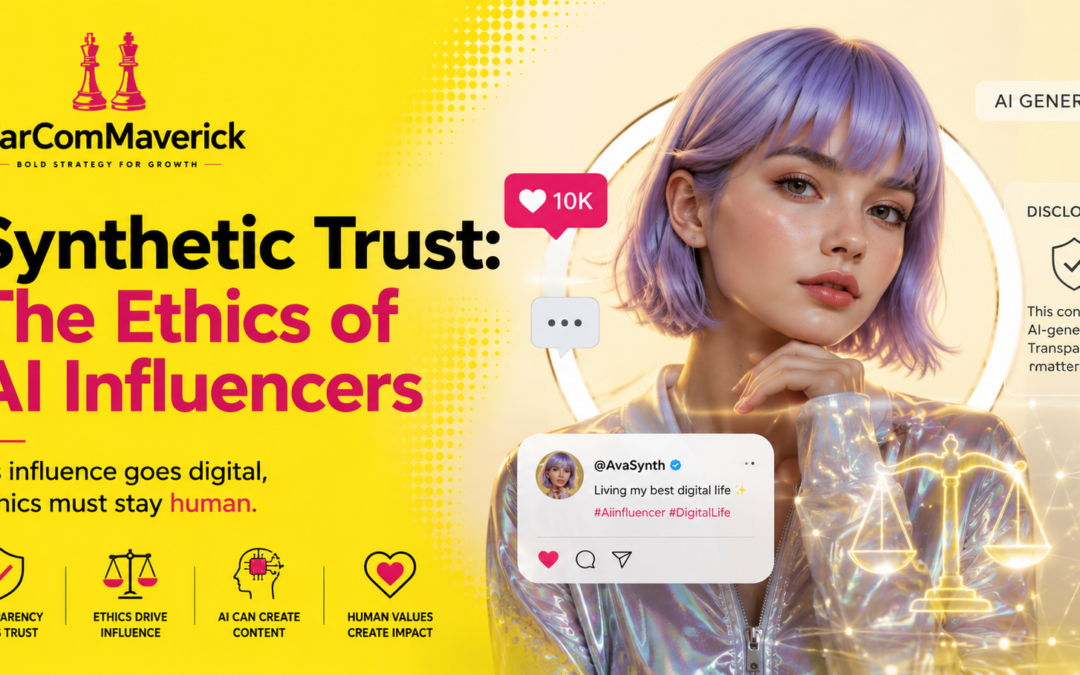
I recently watched a skincare review from a creator with flawless, poreless skin, a soft voice, and roughly four million followers. She has never had a breakout in her life. She has never had skin. She isn’t real, and her brand deal was… Read more about the upcoming articles at Best AI Digital Marketing Blog in Chennai | MarComMaverick
Welcome to the strangest chapter yet in digital marketing: a moment where the influencer selling you the serum has never touched a mirror, and the advertising still works.
I’m Dr. Chitra K. Ravishankaran, and I’ve spent two decades studying why people trust the brands and voices they trust. Nothing has tested that research quite like the last eighteen months. Fully AI-generated influencers are now landing real brand deals, running real campaigns, and moving real sales, while regulators scramble to write rules for a category of “person” that legally doesn’t exist. This is exactly the kind of shift we exist to decode at MarComMaverick, India’s Best AI Digital Marketing Blog in India for digital marketing, advertising, and marketing strategies before they hit the mainstream.
Let’s sit with the discomfort of that for a minute, because it’s worth sitting with.
When the Face Selling You a Serum Has Never Had Skin
India already has its own cast of virtual endorsers. Kyra, built by a Mumbai studio, has fronted campaigns for boAt and shown up in Amazon India’s festive sale push. Naina turns up at real-world events standing next to real celebrities, quietly blurring a line most of us assumed was permanent. Radhika, a bilingual Tamil-English travel persona, is perpetually on holiday and never once needs a visa. None of them sleep, age, cancel a shoot, or say something regrettable at 1 a.m. From a pure digital marketing standpoint, that reliability is the entire pitch, and it’s a genuinely omnichannel marketing pitch at that: the same persona can front an e-commerce banner, a festive sale campaign, and a magazine cover in the same week, without a single scheduling conflict.
This is where advertising gets interesting, philosophically speaking. An endorsement has always rested on a simple contract: this person used the product, and here is their honest reaction. AI-generated influencers can’t honestly react to anything. They can only be directed to appear as though they did. That’s not automatically dishonest, but it does mean the marketing strategies built around them need an entirely new definition of what a “genuine” endorsement even is.
The Philosophy Problem: What Even Is Authenticity Anymore?
Here’s where my doctorate finally earns its keep outside a viva voce.
Media ethics has argued for decades over what makes a communicated experience “authentic” – whether authenticity requires a real, embodied person having a real experience or whether it simply requires consistency, coherence, and honesty of intent. AI influencers force that argument out of the seminar room and into the advertising budget. If a synthetic creator never claims to be human, is the endorsement still deceptive? Consumer psychology suggests the answer depends less on philosophy and more on perception: audiences form parasocial trust with a face and a voice long before they consciously register whether either one is real.
That’s the uncomfortable part. Our brains do not appear to have a separate trust circuit reserved exclusively for humans. A consistent, warm, responsive persona builds the same parasocial trust whether there’s a person behind it or a render farm. Marketing strategies that exploit this without disclosure aren’t just an ethics footnote; they are a direct exploitation of a well-documented gap in consumer psychology.
Regulators Are Scrambling, and Honestly, They Should Be
Every major regulator is now writing rules for something that barely existed three years ago, and the pace picked up sharply in 2026. In the United States, the FTC’s Endorsement Guides now cover virtual and AI-generated influencers: if a brand pays for or controls a synthetic endorsement, the material connection must be disclosed exactly as with a human creator, and presenting an AI persona as real without disclosure counts as deceptive. The EU’s AI Act goes further Article 50’s transparency obligations, covering labelling of AI-generated content, apply in full from August 2026. New York has its own synthetic-performer disclosure law taking effect the same year.
India is not sitting this one out either. The IT Rules amendments that came into force in early 2026 add fresh obligations around AI-generated content, and ASCI guidelines now expect clear, upfront disclosure whenever an endorser is virtual rather than human. For any brand running digital marketing campaigns with an Indian audience, that means the “she’s not real” disclosure isn’t a nice-to-have. It’s the advertising equivalent of a seatbelt law.
What all of this adds up to is a single, simple principle sitting underneath a genuinely messy patchwork of regional advertising law: if a real person could reasonably be mistaken for behind the endorsement, tell people when that isn’t true. Everything else is an implementation detail. Compliance teams are already leaning on AI tools to audit disclosure at scale, since no legal department can manually review every post a virtual influencer touches across an omnichannel marketing calendar that spans Instagram, YouTube, WhatsApp catalogues, and paid media in the same week.
Building Marketing Strategies Brands Can Actually Defend
So where does that leave a brand trying to build honest, effective marketing strategies in 2026?
Start with disclosure by design, not disclosure as damage control. The strongest omnichannel marketing playbooks I’m seeing right now bake the “AI-generated” label into the content itself, not into a buried caption line nobody reads. Platforms are helping here: Content Credentials and provenance metadata are now supported across the major networks, which means the right AI tools can attach a verifiable, tamper-evident label to synthetic content the moment it’s created, rather than relying on a creator’s goodwill after the fact.
This matters more in omnichannel marketing terms than single-post terms. A disclosure that lives only on Instagram doesn’t survive the moment that clip gets reposted to YouTube Shorts, clipped into a WhatsApp forward, or picked up by a review aggregator. A defensible omnichannel marketing strategy carries the AI-generated label with the asset itself across every surface it touches, rather than trusting each platform to re-apply it correctly.
Second, match the persona to the claim. A virtual influencer talking about a phone case’s aesthetic is a low-stakes use of AI tools. A virtual influencer claiming a supplement cured their anxiety is an entirely different risk category because there was never a real nervous system involved to make that claim truthful in the first place. Good marketing strategies, backed by AI tools that flag high-risk claim categories automatically, draw that line deliberately, not by accident.
Third, treat AI tools as a genuine third category, not a cheaper version of a human creator. The Indian influencer market has watched the cost of building a brand-ready virtual persona fall by more than ninety per cent in four years, which means the decision to use these AI tools is now a strategic choice, not a budget compromise. The brands getting real value are using AI tools for consistency, localisation, and an always-on presence, while still keeping human creators for the moments that genuinely require lived experience. The AI tools themselves aren’t the ethical problem here; treating them as a shortcut around honesty is.
None of this is a reason to avoid AI-generated influencers. It’s a reason to be honest about what they are. Consumer trust, once you notice it was built on a misunderstanding, doesn’t come back cheap. The brands that will still be trusted in five years are the ones treating disclosure as part of the creative brief today, not as legal’s problem to solve later. That’s the version of digital marketing, advertising, marketing strategies, and omnichannel marketing we keep decoding at MarComMaverick, the Best AI Digital Marketing Blog in India built for exactly this kind of grey area.
If synthetic creators are going to keep selling us serums, the least the advertising industry owes us is honesty about who, or what, is actually talking.
The Bigger Ideas Behind This Piece
A few broader concepts sit underneath everything above, for readers who want to go deeper:
- Media ethics – The philosophical framework for judging honesty and harm in communicated experience, now stretched to cover synthetic personas.
- Philosophy of authenticity – The long-running debate over whether authenticity requires a real, embodied experience or simply consistency and honest intent.
- Consumer psychology – How trust, identity, and perception shape buying decisions, whether the face on screen is real or rendered.
- Neuromarketing – The science of how the brain forms trust and recognition responses to a face and voice, regardless of whether either is human.
- Parasocial trust – The one-sided emotional bond audiences form with a persona over time, which AI creators can now trigger as reliably as human ones.
- Omnichannel marketing – The discipline of keeping disclosure, tone, and message consistent across every platform a synthetic or human creator appears on.
If any of these deserve a deeper dive, that’s exactly the kind of decoding you’ll find on my Medium page and across upcoming pieces on MarComMaverick, India’s Best AI Digital Marketing Blog in India for brands that want their marketing strategies and omnichannel marketing plans to survive contact with a regulator.
#DigitalMarketing #Advertising #MarketingStrategies #AITools #OmnichannelMarketing #AIInfluencers #SyntheticMedia #ConsumerPsychology #MediaEthics #MarComMaverick #Influencermarketing #Influencers #AffiliateMarketing #Neuromarketing
Read the article in LinkedIn and Medium Platform
Dr. Chitra K. Ravishankaran holds a doctorate in advertising and marketing, and writes on the ethics, psychology, and strategy behind digital marketing, advertising, and marketing strategies for Indian brands. Connect with her on LinkedIn, read more of her thinking on Medium, and explore more from India’s Best AI Digital Marketing Blog in India at MarComMaverick.